Board Theory
- mhpluggedin
- Jun 1, 2021
- 5 min read
I have been taking guitar lessons lately – despite the fact that I started playing when I was 5 years old – and have reacquainted my fingers with scales and basic music theory. It hasn’t been easy.
I discovered through this “re-acquaintance” that I could develop new formulas from a completely different perspective, in this case, about Boards.
Why music? I’ll paraphrase something I read recently in the New Yorker about scent. Music, like scent, shares a resistance to verbal description, even by the most eloquent writers. There is an objectivity or distance between people, yet sound or music seems to leapfrog this gap. Music evokes an aesthetic sensation and envelops us in a world that neither critical reason or analytics can fully explain.
The starting point of music theory is the major scale, at least for a guitarist, which consists of 7 notes. The way you unfold or build a major scale is using the following formula of half/whole steps (W-W-H-W-W-H-W): Thus, a C scale is:
C-D-E-F-G-A-B
If you want to create a different sound, you might choose a minor scale. In turn, a C minor scale would be:
C-D-Eb-F-G-Ab-Bb
In other words, to change a major scale to a minor scale is accomplished by flattening the 3rd note of the major scale – the opposite of sharping a note.
Now imagine that you were trying to either describe or construct a start-up Board based on music theory. If you were creating a new Board, you could measure the frequency of each board candidate, and align those candidates with a scale, determining the overall “sound” of the Board.
If you wanted something bland and straightforward like the notes in a major scale, you would follow the major scale. If you thought, you needed some “Blues” in your Board, you would find someone in the group whose frequency is equal to the 3rd note of the scale and is flattened, at least musically speaking.
By the way, I am not necessarily proposing that we should construct a Board that is “harmonious.” Cacophony in some “sense” is in the ears of the beholder and can represent logical dissent or dysfunctionality – look no further than WeWork to illustrate the need for dissent. But most of us can hear when an incorrect note in a scale or chord is played. You simply know it. If such a note were deliberate – like logical dissent – you would get that too after careful listening.
There are many modes of the Major scale, including Dorian, Phrygian, Lydian, Mixolydian, Aeolian, and Locrian, and each of these modes have a different sound, similar, in a sense, to the unique frequency a person has.
To this, I refer to a bio-feedback expert, who once said to me:
…humans are a dynamic, conglomerate of frequencies that produce a resonance. The brain is producing thousands of different frequencies/second. As is the heart. There are mechanical frequencies produced by breathing, circulation pulse, and gut motility. All of this combines to create a coherent (harmonic) or incoherent (dissident) resonance with an amplitude (voltage).
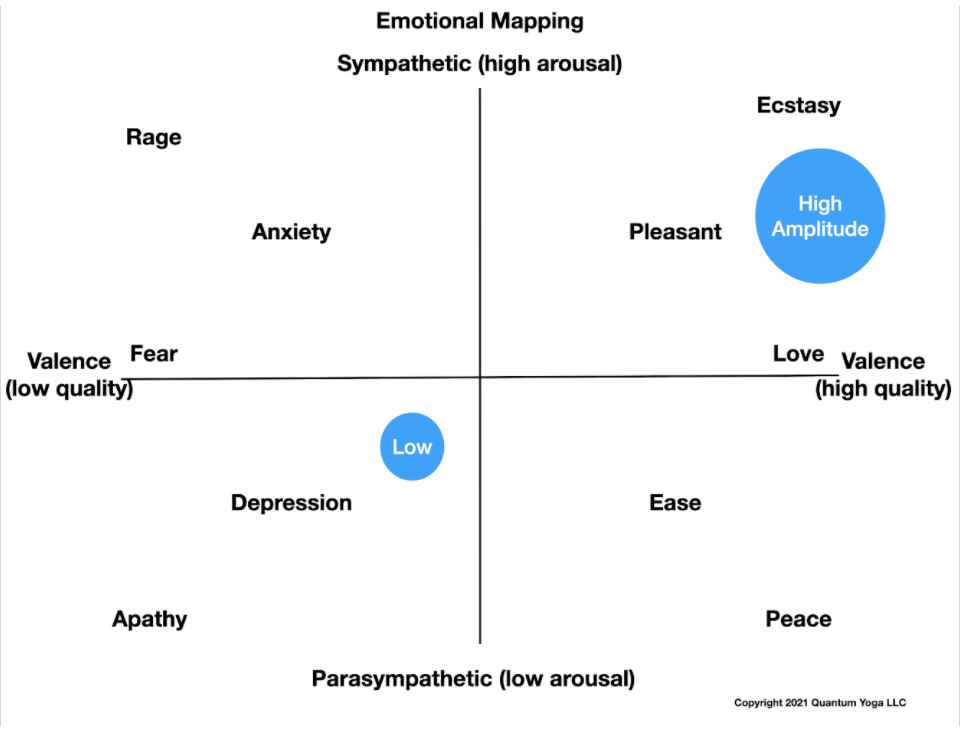
In the biofeedback world, your frequency could be a leading indicator for different feelings from fear to love. In the graph below, for example, you can think of “valence” –the x-axis — as positive or negative, or in musical terms, consonance and dissonance, or harmonic and discordant. The y-axis, sympathetic and parasympathetic, refers to high and low energy, which can be translated in music as fast or slow tempo.
Most of the time, however, your typical CEO is not able to place sensors on board members, and as such, this technique is not practical.
Another colleague of mine argues that we do have “sensors” that are invisible – not physically attached to board members. These invisible sensors are the body’s innate exteroceptors (a receptor that detects external stimuli) and nociceptors (a sensory receptor to painful stimuli) that can sense “signals” – perhaps a form of biofeedback – to trigger both our sympathetic and parasympathetic pathways. For me, the music of the board is a far simpler method.
Before we go any further, let’s understand chords because a Board is a collection of individuals acting – at least most of the time – as a group, like a chord. Each person might have their own distinct frequency, which is meaningful; but the total picture of the sound only becomes clear in the context of when the board members are working together.
Many of you who have worked with Boards have found that what one board member says privately may not be the same publicly, especially in actual Board meetings. Such changes can happen due to in the moment pressure from other board members. Or, the board member just didn’t have the heart to reveal his or her thoughts to you. Both have happened many times to me.
Board members can be willows in the wind, just like politicians, except, of course, when it comes to making money. In this case, they are steadfast.
Knowing this “flexibility” means that we can ultimately distinguish transitional chords from non-transitional ones, analogous to “strong” vs “weak” board members.
Most of the time, a chord is defined as a combination of at least three notes, and are built off a root note. There are many different types of chords – Major, Minor, Augmented, Diminished, etc. Each of these chord types has corresponding rules. For example, the chord formula for major chords is:
1-3-5
So, a C Major chord has (minimally) the notes:
C-E-G
Which are the first, third, and fifth notes of the C Major Scale:
C-D-E-F-G-A-B
Similarly, a C Minor Chord’s formula is:
1-3b-5
Therefore, the notes of C Minor Chord would be:
C-Eb-G
If we get anything out of this exercise, we can surmise that a Board, like a chord, needs at least three people, and of the three, we can flatten or sharpen one of its members to attain a certain sound, frequency or behavior.
If your Board, for example, has nine directors, that’s probably too many. Remember, on a guitar, you can’t have more than 6 notes in a chord because you only have six strings!
You, of course, could bring in a piano, and play a chord with 10 notes.
Still, I think we can all agree that we would still evaluate each board member to determine whether or not they “overlap” or are “repetitive” — producing the same sound, individually or in concert. If there is an overlap, then that particular board member should be dropped or not admitted to the fiduciary.
Above and beyond producing the same sound, are there any board members whose dissidence or diminished tone overwhelms the rest of the “notes?” In Silicon Valley parlance, such dissidence is called toxicity, and diminished is called “no guts.”
Now you might automatically assume that you would never want a diminished sound for a Board. But that’s not always true. Since diminished chords are typically transitional, one could happily accept that a board will change over time, especially for start-ups, who will grow up to be more “aggressive” but hopefully not toxic.
This is what Wikipedia says chords connote:
· Major chord = happy and simple
· Minor chord = sad
· Diminished chord = tense and unpleasant
· Major seventh chord = thoughtful and soft
· Minor Seventh = moody contemplative
· Dominant seventh = strong and restless
· Suspended chords = bright and nervous
· Augmented chord = anxious and suspenseful
My favorite chords are Major Seventh Chords – thoughtful and soft – but I have often found myself in Boards whose sound is augmented (anxious and suspenseful), especially if the investors on the board are having their own capital challenges.
I could also add that Board improvisation can be risky if not well practiced. I am having a hell of a time working out limitless arpeggios of just F minor, G7, and C7 – introductory chords in Lullaby of Birdland.